
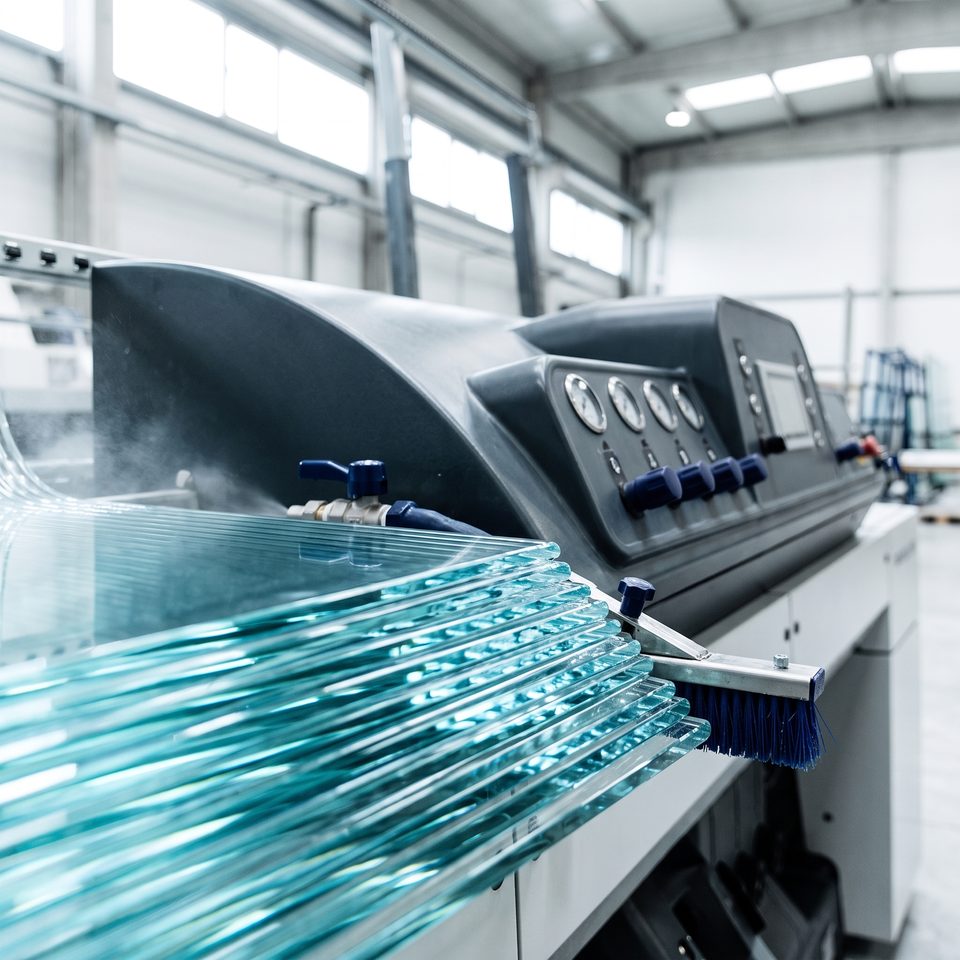
GLASS EDGE GRINDING
After cutting, the glass edge is sharp and has micro-cracks, from which a crack across the whole sheet can start on impact or heating. Grinding solves this problem: it smooths and rounds the edge, making the glass safe to touch and more resistant to damage.
We grind edges flat or with a slightly rounded profile, with a matt or polished finish. It is the basic processing before tempering and essential wherever the edge stays exposed - in table tops, shelves, frameless doors and mirrors.
TYPES OF EDGE GRINDING
An arrised edge only removes the sharp edge - enough when the glass will be hidden in a frame. A flat matt grind gives an even, flat edge for visible elements. A polished edge is glossy and clear and is chosen for furniture, mirrors and display glass.
GRINDING MEANS SAFETY
The edge is the weakest point of a sheet. Glass with a ground edge copes better with sudden temperature changes, e.g. strong sunlight on part of the pane, and breaks less often during installation. That is why we also grind the edges of glass that later goes on to tempering.

Frequently asked questions
-
Does glass for a frame also need grinding?
An arrised edge, which removes the sharp edge and micro-cracks, is usually enough. A full flat or polished grind makes sense when the edge will be visible.
-
What is the difference between a matt and a polished edge?
A matt grind gives an even, smooth edge with a milky look. Polishing is the next stage - the edge becomes glossy and clear like the rest of the sheet.
-
Can tempered glass be ground?
No. We grind the edges before tempering. After tempering, any mechanical processing risks the sheet shattering.
 730 888 911
 kontakt@kamarglass.pl