
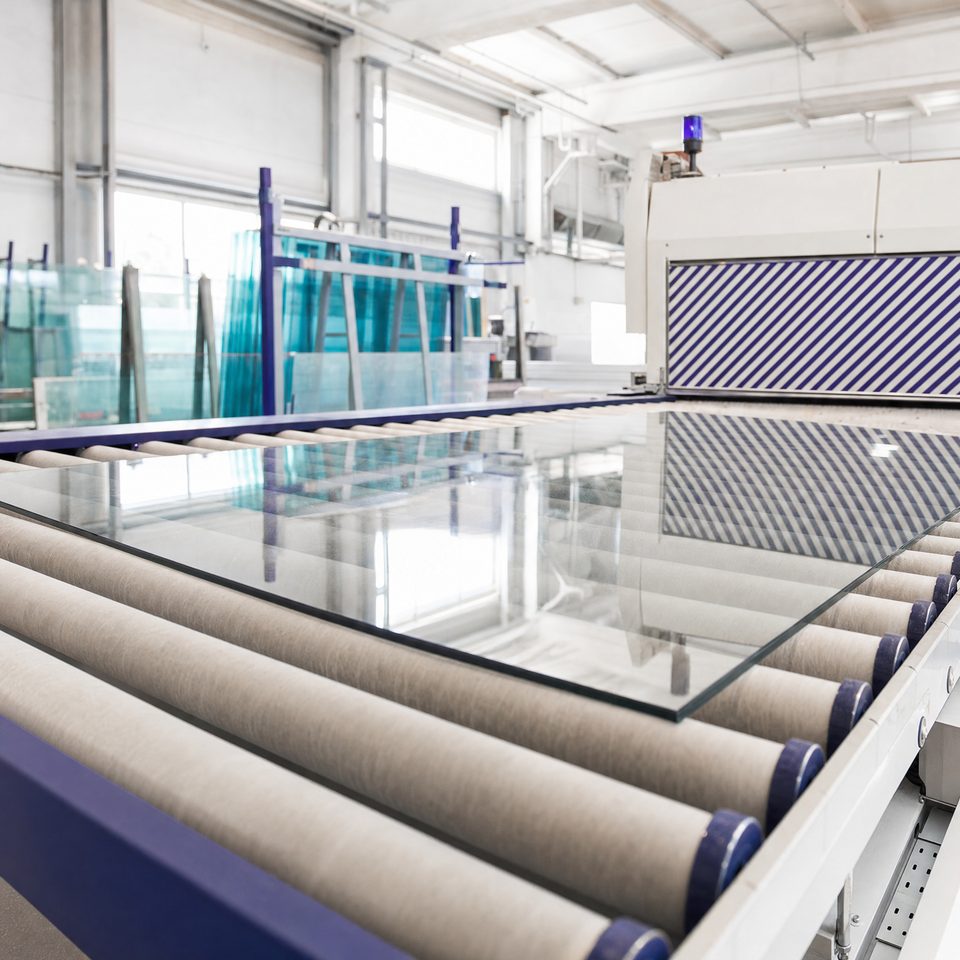
GLASS TEMPERING
Tempering is a heat treatment that makes glass several times more resistant to impact and bending and able to withstand large temperature differences. The sheet is heated to close to its softening point and then rapidly cooled with a stream of air. This creates stresses in the glass that work in its favour - the appearance of the sheet does not change, but its strength does.
Tempered glass (ESG) is also safety glass. When it breaks, it shatters into small pieces with blunt edges rather than sharp shards. That is why it is used in doors, shower enclosures, balustrades, table tops and anywhere glass is exposed to impact or heat.
PROCESSING FIRST, THEN TEMPERING
Tempered glass can no longer be cut, drilled or ground - any such attempt makes the sheet shatter. That is why we make the dimensions, holes, cut-outs and edge processing before tempering, based on the design. The sooner we receive the full specification, the more certain it is that the element will go to installation without corrections.
TEMPERING AND WHAT COMES NEXT
Tempered glass often goes further: to lamination, where a laminate of tempered sheets is made for balustrades and canopies, or to assembly into an insulating glass unit. We also temper glass painted with ceramic paint - the paint is then fired in the process and permanently bonds with the surface.

Frequently asked questions
-
Can I drill a hole in tempered glass?
No. Damaging the surface of a tempered sheet makes it shatter into small pieces. We make holes, cut-outs and edge processing before tempering, so their position and dimensions must be agreed when ordering.
-
What is the difference between tempered and heat-strengthened glass?
Tempered glass (ESG) is stronger and shatters into small pieces when broken. Heat-strengthened glass (TVG) is stronger than ordinary glass but breaks into larger fragments, which stay in the frame longer in a laminate. That is why TVG is mainly chosen for laminates and facades.
-
Does glass look different after tempering?
No. The colour, clarity and surface stay the same as before processing. The difference only shows under load and when the glass breaks.
 730 888 911
 kontakt@kamarglass.pl